What breaks YouTube’s spam policy: clickbait, mass production, detection evasion and scraped content (November 2026)
Shortsmith team · Updated
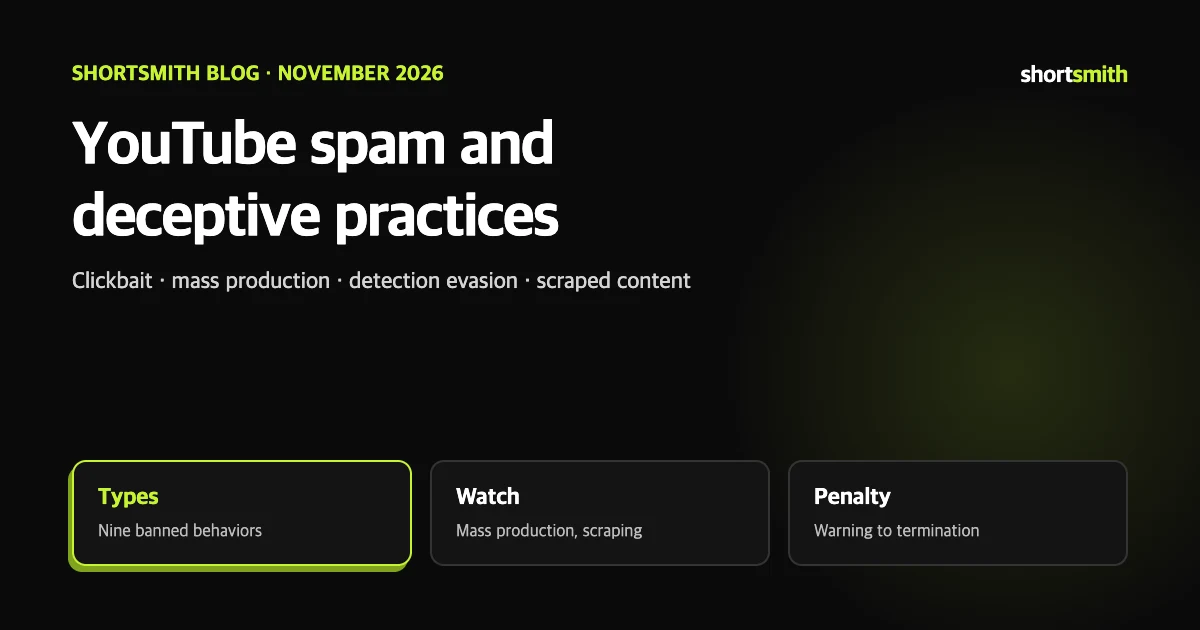
Shorts come in large numbers, which makes automation tempting and brings the risk of being labelled spam closer. YouTube’s spam policy is not only about flooding comments. It covers titles and thumbnails, links, upload patterns and even editing techniques, and a violation can end in demonetization or a terminated channel.
This guide is based on the YouTube Help page “Spam policy”, read on November 3, 2026. The policy says it applies to all types of content on YouTube, including public, unlisted and private content, comments, links, posts, thumbnails and organized channel networks. We have arranged it as a checklist in the order Shorts creators are most likely to trip.
The nine types at a glance
Help says the list is only a set of examples. It also states that asking viewers to like, comment or subscribe is allowed; the problem is paying for engagement or forcing it.
| Type | What is banned | Official example |
|---|---|---|
| Engagement manipulation | Inflating engagement with bots, coercion or rewards | Organized sub-for-sub schemes |
| Fake engagement | Using polls or image posts to force engagement | Mass-posting low-quality “like food? tap the heart” polls |
| Comment spam | Mass repetitive or deceptive comments or chat | The same “check out my channel” on hundreds of videos |
| Off-platform redirection | Content made only to send people off YouTube | A “free movie” video linking to a malware URL |
| Detection evasion | Technical tricks to get around abuse detection | Mirror-flipping a TV episode to avoid detection |
| Automated mass production | Mass-making similar content with minimal edits | Same background music, repeated AI images, AI script read as is |
| Scraped content | Re-posting without original commentary or editing | Re-uploading popular clips with no reaction or commentary |
| Scams | Get-rich-quick pitches, fake jobs, fake support contacts | Posing as a company to steal logins with a “free giveaway” link |
| Malicious clickbait | Titles, thumbnails or descriptions that mislead | A “full match” title with only a few clips inside |
Three things Shorts creators should watch
The first is automated or synthetic mass production. Testing a new production tool or posting a few versions of a video is fine, but flooding the platform with near-identical content that had minimal edits is not. Organized mass production or technical tricks meant to get around filters or deceive viewers also count. The official example is a channel that uses the same background music and repetitive AI images across many videos and reads AI-generated scripts as they are.
The second is scraped content: re-posting material from other sites or platforms, or other people’s videos, without original commentary, educational value or distinctive editing. A channel that turns other people’s videos into Shorts should be able to point to where its own commentary and editing went in. Our reused content guide covers monetization standards.
The third is malicious clickbait. This is not an intriguing title in itself; it is a title, thumbnail or description that misleads people into clicking something different from the real content. If the scene your title promises is not in the video, that is a warning sign.
How to read “detection evasion”
The policy bans technical manipulation such as speeding up audio, applying excessive filters or cropping the frame when it is done to get around abuse detection. The key is purpose: ordinary edits that make a video look better are not the issue, while changes meant to fool a system are. If you find yourself looking for ways to avoid detection, that alone may signal the video has a problem.
Since the official example is mirror-flipping a TV episode, lightly altering someone else’s content is not a safe route. Start by checking whether you may use the material at all. Using CC BY videos that allow reuse is covered in our CC BY guide.
Disclose AI, but disclosure is not a pass
The policy says creators must disclose when content is generated or significantly altered with AI. It also says disclosure does not make a violation acceptable, and that the Community Guidelines apply to all content, including AI-generated or AI-altered content. How to label is in our AI label guide.
What happens if you break it
- Monetization can be suspended, or the channel or account can be terminated.
- For some violations the content is removed and the channel gets a warning or strike, with an email notification.
- Taking the optional policy training lets a warning expire after 90 days. A repeat violation of the same policy within 90 days means it does not expire and a strike can follow.
- Three strikes within 90 days can terminate the channel.
Questions to ask before you post
- Is the scene my title and thumbnail promise actually in the video?
- Does this video contain my own commentary, editing or point of view, rather than a straight copy?
- Am I repeating the same music, images and script structure just to raise the count?
- Do links in the description lead somewhere risky, or is sending people off YouTube the video’s only purpose?
- Have I gone past asking for likes and subscribes into rewards or pressure?
- If the video was made or heavily changed with AI, did I label it?
If you use Shortsmith
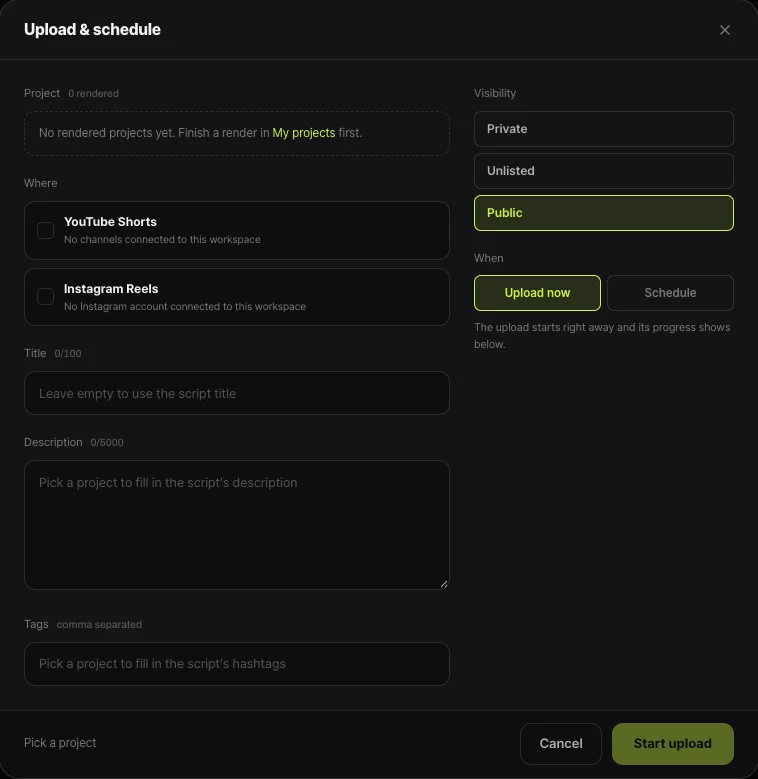
In Shortsmith’s upload window, choosing a project fills in the title, description and hashtags from the script, and you can read and edit them before posting. Check there that the title honestly describes the video. When it uploads a realistic AI-made video (a short drama) to YouTube, Shortsmith turns on YouTube’s altered or synthetic content label.
Being able to make videos quickly with automation is different from being allowed to stamp out the same video in bulk. Writing the brief so each episode has a different subject and commentary, and looking at how different episodes are before how many, is the safer way to stay inside this policy. That is our suggestion.
FAQ
Is asking viewers to subscribe spam?
No. Asking for likes, comments or subscribes is allowed. Giving rewards or applying pressure for them is the problem.
Are all AI-made videos spam?
No. Testing new tools or posting a few versions is allowed. Flooding the platform with near-identical content that had minimal edits is not.
Will a dramatic title count as clickbait?
The policy bans malicious clickbait: titles, thumbnails or descriptions that mislead people about the real content.
Can I cut someone else’s video into Shorts?
Re-posting it without original commentary or distinctive editing can be treated as scraped content. Check you may use the material first.
Does breaking the policy remove my channel immediately?
Some violations start with removal and a warning, and three strikes in 90 days can terminate a channel. Depending on severity, demonetization or termination can come sooner.
Does disclosing AI use excuse a violation?
No. Disclosure does not make a violation acceptable, and the Community Guidelines apply to AI content too.
Sources
- Spam policy — YouTube Help · checked
- Fake engagement policy — YouTube Help · checked