AI video labeling rules on YouTube, TikTok and Instagram (October 2026)
Shortsmith team · Updated
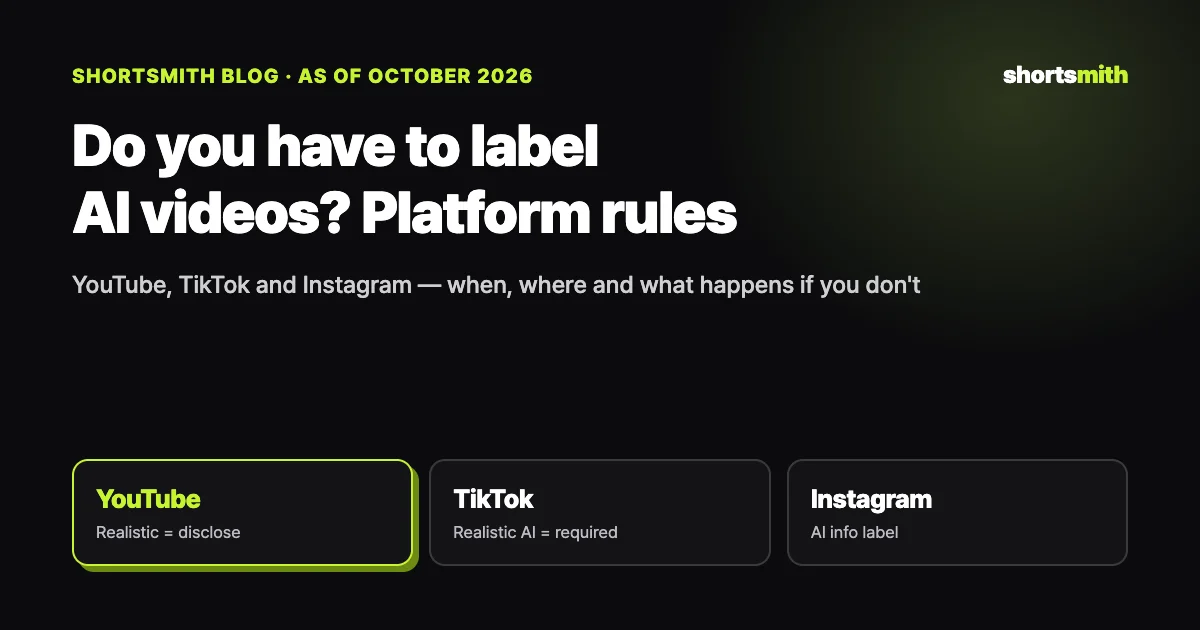
YouTube, TikTok and Instagram all ask you to flag AI-made videos that look real. On YouTube you answer the AI use question at upload, on TikTok you turn on the AI-generated content setting when posting, and on Instagram an AI info label is added. Obvious animation and light edits such as captions or color correction usually don’t need a label.
We checked the YouTube and TikTok help centers and Meta’s official announcement on October 13, 2026 to summarize what each platform requires, where to turn the label on, and what happens if you skip it. We also cover South Korea’s AI Basic Act, which took effect in January 2026, and whether its labeling duty applies to creators.
AI labeling rules at a glance
| Platform | What needs a label | Where to turn it on | If you don’t |
|---|---|---|---|
| YouTube | Realistic altered or synthetic content (a real person saying or doing something they didn’t, altered real events or places, and more) | Upload flow → AI use → Yes | YouTube may add the label; repeat misses can mean removal or YPP suspension |
| TikTok | Realistic AI-generated content (required); significantly AI-edited content (encouraged) | Post screen → More options → AI-generated content | Content may be removed under the Community Guidelines |
| Realistic video or images made or heavily edited with AI | Add the AI label when posting (app) | An AI info label is added when AI signals are detected |
YouTube — turn on AI use when it looks real
YouTube asks creators to disclose content that is meaningfully altered or synthetically generated when it looks realistic. The help center lists four cases: making a real person appear to say or do something they didn’t, altering footage of a real event or place, generating a realistic scene that didn’t happen, and creating music that is the main focus of the video.
Clearly unrealistic content — riding a unicorn, an animated missile — doesn’t need disclosure, and neither do minor edits such as beauty filters, color correction, captions, upscaling or audio clean-up. Using AI for scripts, titles or thumbnails is also exempt, as is cloning your own voice for a voice-over.
To disclose, choose Yes for AI use in the attributes section during upload. Realistic videos may get a label on the player itself; animated or stylized ones get it in the expanded description. YouTube says disclosing doesn’t limit your audience or affect monetization eligibility, but creators who repeatedly fail to disclose may have the label applied for them and face penalties such as content removal or suspension from the YouTube Partner Program.
TikTok — realistic AI content must be labeled
TikTok encourages labels on content that is fully generated or significantly edited by AI, and its Community Guidelines require a label on AI content containing realistic images, audio or video. Its examples of significant edits include a subject portrayed doing something they didn’t do (for example, dancing), saying something they didn’t say, or altered so much — as with a face swap — that they are no longer recognizable.
You turn the label on while posting: after selecting your video, tap Next, then More options, and switch on AI-generated content. The post then shows “Creator labeled as AI-generated.” TikTok says turning this on won’t affect distribution as long as the video follows the Community Guidelines.
TikTok can also label content automatically. Videos made with TikTok AI effects, or AI videos carrying C2PA Content Credentials metadata, receive an “AI-generated” auto label — and once applied, an auto label can’t be removed.
Not allowed even with a label
TikTok does not allow AI content showing fake authoritative sources or crisis events, public figures appearing to endorse something, the likeness of anyone under 18, or adult private individuals without their permission — labeled or not.
Instagram and Facebook — the AI info label
Meta began labeling AI-generated video, audio and images in May 2024. An “AI info” label is added when Meta detects industry-standard AI signals in the file or when the creator discloses the content as AI. From July 2024, content that was only edited with AI shows the label inside the post menu, while content generated by AI shows it on the post itself.
Meta also says it may add a more prominent label when digitally created or altered media carries a particularly high risk of materially deceiving the public on an important matter. If you post realistic AI video, adding the AI label yourself when posting is the most reliable approach.
What about South Korea’s AI Basic Act?
South Korea’s AI Basic Act took effect on January 22, 2026 and requires generative AI outputs distributed outside a service to carry a notice that they were made with AI. According to reporting that cites the Ministry of Science and ICT, the duty falls on businesses that provide AI products and services — ordinary users who create and post AI content are not covered.
Deepfakes that are hard to tell from reality must be marked so viewers can clearly recognize them, while non-deepfake outputs such as animation or webtoons may use invisible marks like digital watermarks. The law allows fines of up to 30 million won, but the government has said it will run a grace period of at least a year. For individual creators, the platforms’ own labeling rules are what matter day to day.
How to post videos made with Shortsmith
When you publish a Shortsmith short drama straight to YouTube, the server turns on YouTube’s altered or synthetic content setting for you. Instagram doesn’t let outside apps set this, so Shortsmith reminds you to turn on the AI label in the Instagram app after posting. We don’t burn “AI generated” text into the video itself — the platform labels tell viewers the same thing more precisely.
Viral motion clips, where a real-looking person appears to dance, fall under the TikTok and YouTube rules above. When you download and post one, turn on AI-generated content on TikTok, AI use → Yes on YouTube, and the AI label on Instagram. Regular Shorts editing — picking cuts or changing captions on your source footage — and AI-written scripts and voice-overs don’t require disclosure under YouTube’s rules.
FAQ
I only used AI for the script and voice-over. Do I need to disclose?
YouTube says production help such as scripts, titles and thumbnails, and audio or caption fixes, don’t need disclosure. If you imitate a real person’s voice to make them say something they didn’t, you do.
Will an AI label hurt my views or earnings?
YouTube says disclosing doesn’t limit your audience or affect monetization eligibility, and TikTok says turning on the AI-generated content setting won’t affect distribution.
Do animated or stylized AI videos need a label?
Under YouTube’s rules, clearly unrealistic content doesn’t need disclosure. TikTok still encourages labels when the subject is altered beyond recognition, so it is safer to turn it on there.
Can I add the label later?
On YouTube you can change it by editing the video details in YouTube Studio. An “AI-generated” auto label added by TikTok can’t be removed.
Can an individual creator be fined under Korea’s AI Basic Act?
Reporting on the ministry’s guidance says the labeling duty applies to businesses providing AI services, not to users who make and post AI content. Platform rules still apply separately.
Sources
- Disclosing use of altered or synthetic content — YouTube Help · checked
- About AI-generated content — TikTok Help Center · checked
- Our Approach to Labeling AI-Generated Content and Manipulated Media — Meta · checked
- AI Basic Act takes effect tomorrow (Korean) — Newsis · checked