Monetizing Shorts made from other people’s videos: reused content, fair use and Content ID (October 2026)
Shortsmith team · Updated
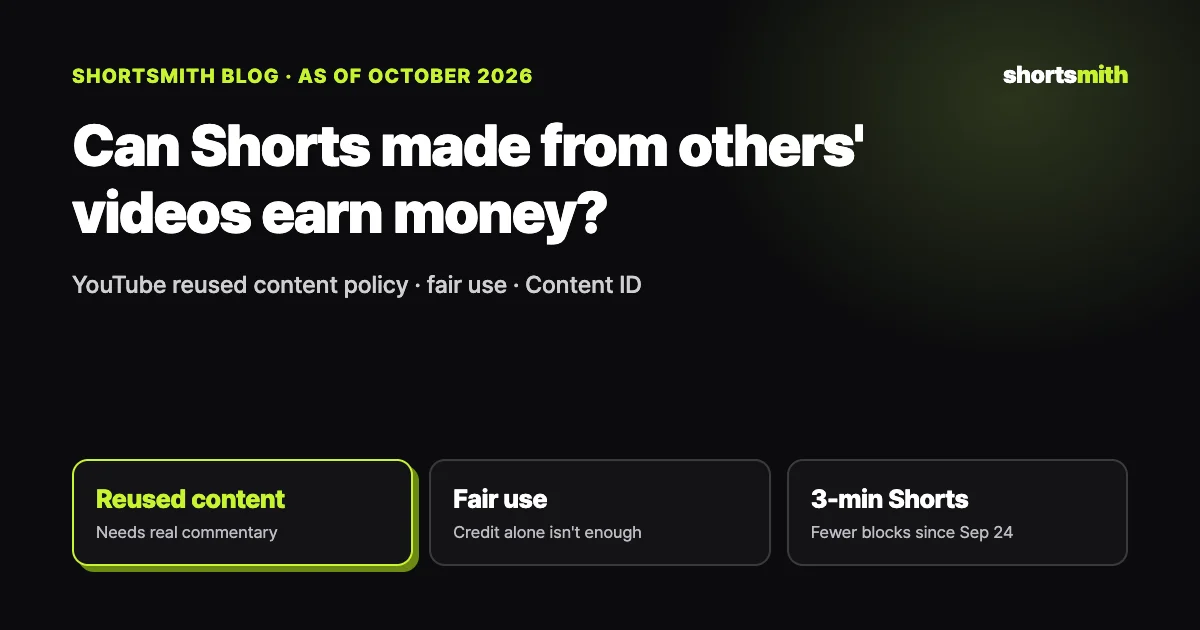
Shorts that use someone else’s videos can still earn money. YouTube allows monetization when you add meaningful commentary or substantial editing, such as critique, commentary, a story recap or a reaction. Channels that stitch clips together or repost videos from other platforms are treated as “reused content,” which can switch off monetization for the whole channel, and that applies even when the original creator gave permission.
We checked YouTube Help Center pages on October 15, 2026: the channel monetization policies (reused content and repetitive content), fair use, and three-minute Shorts with Content ID. Monetization policy and copyright are separate standards, and you need to meet both.
At a glance — what can and can’t be monetized
| Can be monetized | Can’t be monetized |
|---|---|
| Using clips to critique them | Clips of your favorite show stitched together with little or no commentary |
| Game replays with your own explanation of the plays | Compilations of short videos collected from other social platforms |
| Reactions where you give your opinion on the original | Content downloaded or copied without meaningful changes |
| Edits that add a story and commentary to another creator’s video | The same creator’s content uploaded many times |
| Videos where audio or visual effects show substantial editing | Non-verbal reactions that get most of the views without commentary |
What is reused content? It’s judged per channel
YouTube treats a channel as reused content when it repurposes material already on YouTube or elsewhere online without meaningful commentary, substantial modifications, or educational or entertainment value. The key point is that YouTube reviews the whole channel, not one video. If the center of your channel is content where it isn’t clear you made it, you can be rejected from the Partner Program or lose monetization you already had.
This policy is separate from copyright. Even with the original creator’s permission, and even with no Content ID claims at all, a channel can still count as reused content. The test is not “did I get permission?” but “is my own editing and commentary the heart of the video?” Videos that only read website or news text aloud, and songs with only the pitch or speed changed, fall short for the same reason.
Watch out for repetitive (mass-produced) content too
YouTube also blocks monetization for videos that look template-made or so alike that they could replace each other when watched back to back. Since July 15, 2025, this policy has been called “inauthentic content.” Examples include repeating the same story template every time, slideshows or scrolling text with no narration or commentary, and AI content that looks mass-produced without the creator’s own perspective.
The same intro and outro are fine if the main content differs, and so is a series with recurring characters when each episode tells a different story. When you make Shorts with AI tools, every video still needs a different source, a different story and different commentary. If you make several videos from one source, cover a different event (angle) in each.
Fair use — crediting the creator isn’t enough
Fair use, the copyright standard under US law, weighs four factors: the purpose and character of the use, the nature of the original work, the amount and substantiality used, and the effect on the original’s market. Only courts decide it, case by case. Transformative uses that add new expression or meaning help, and so does using less, but even a short clip can weigh against you if it is the heart of the original.
YouTube lists common myths, too. Crediting the original creator doesn’t make a straight copy fair use, and disclaimers such as “no copyright infringement intended” give no automatic protection. Writing “for entertainment” or “non-profit,” or adding a little of your own material, does not on its own make it fair use. Exceptions differ by country, so creators outside the US should check their local copyright rules as well.
Content ID doesn’t decide fair use
Automated systems such as Content ID can’t judge fair use. If you believe a claim is wrong, you can dispute it. During the dispute both sides can still earn on the video, and the accrued revenue goes to the right party once it is resolved.
Three-minute Shorts and Content ID — what changed on September 24, 2026
Since October 15, 2024, YouTube classifies vertical or square videos up to three minutes as Shorts. Shorts longer than one minute with a Content ID claim used to risk being blocked, but since September 24, 2026, new Shorts longer than one minute and under three minutes keep playing even with an active claim. The rules for Shorts under one minute are unchanged, and a Short blocked worldwide can’t earn money.
Not being blocked doesn’t mean the revenue is yours. Revenue on a claimed video can go to the rights holder, so favor your own uploads, licensed footage, or videos that allow reuse such as Creative Commons Attribution (CC BY). If you do use someone else’s video, make commentary or critique the center of the Short.
Choosing the right job type in Shortsmith
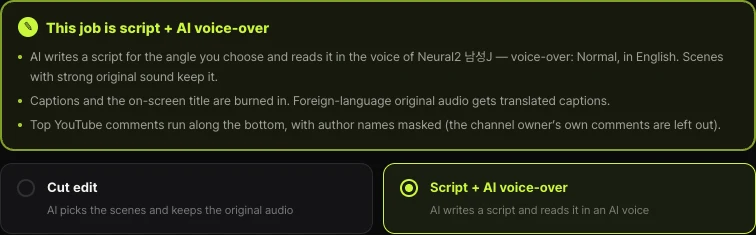
At the top of Shortsmith’s Create page you choose the job type. “Cut edit” lets AI pick scenes and joins them with the original audio, which suits your own videos or footage you have permission to use. “Script + AI voice-over” writes a script for the angle you choose and builds a story by alternating short narration lines with the original audio. If you’re making Shorts from someone else’s video, choose “Script + AI voice-over” so commentary and story structure are part of the result.
At the script stage, Shortsmith checks the narration against the source so it doesn’t add numbers, names or quotes that aren’t there, and picking several angles makes each video cover a different event from the same source. The final call still belongs to the platform and the rights holder, so checking the source’s terms of use first is the safest move.
FAQ
If the original creator gives permission, can I monetize?
Permission only settles the copyright side. The reused content policy applies regardless of permission, so your own commentary and editing have to be the heart of the video.
Isn’t crediting the source in the description enough?
Credit is good manners, but it doesn’t replace fair use or the monetization rules. A straight copy isn’t fair use even when you name the creator.
Can reaction videos be monetized?
Yes, when you share your opinion of the original. Reactions that earn views mostly through silent faces or gestures count as reused content.
Does a Content ID claim put a strike on my channel?
No, a claim is not a copyright strike. The revenue may go to the rights holder or the video may be blocked in some regions, and you can dispute a claim you believe is wrong.
Can AI-made Shorts count as reused or repetitive content?
Yes. AI videos that look mass-produced from a template without the creator’s perspective can lose monetization, so give each video its own story and commentary.
Sources
- YouTube channel monetization policies (reused and repetitive content) — YouTube Help · checked
- Fair use on YouTube — YouTube Help · checked
- Understand three-minute YouTube Shorts — YouTube Help · checked