Making an AI short drama: from a one-line topic to a 9:16 video (October 2026)
Shortsmith team · Updated
An AI short drama starts with a one-line topic: AI suggests story directions, then creates the characters’ faces and voices, the script, the scene video and the subtitles, and finishes a vertical 9:16 video. In Shortsmith it runs in five steps (Theme → Characters → Script → Scenes → Finish), and one 12-second episode at 480p costs about 72 credits. Because the result looks like real people, turn on the AI label when you post it to YouTube or TikTok.
This guide follows Shortsmith’s “Make an AI short drama” screen as of October 18, 2026, together with YouTube’s and TikTok’s help pages on AI disclosure (checked October 13, 2026).
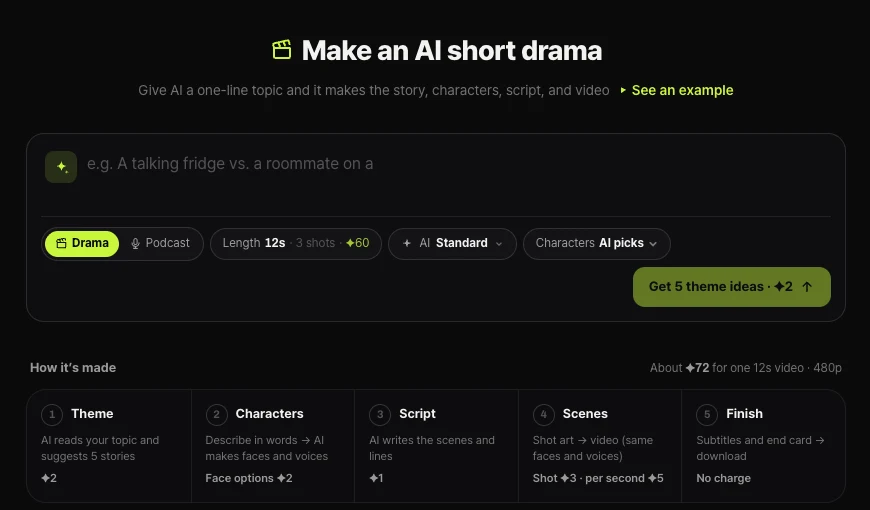
The five steps at a glance
| Step | What happens | Credits (as shown on screen) |
|---|---|---|
| 1. Theme | AI reads your topic and suggests 5 stories | ✦2 |
| 2. Characters | Describe in words → AI makes face options and voices | Face options ✦2 |
| 3. Script | AI writes the scenes and lines; edit by asking | ✦1 |
| 4. Scenes | Shot art → video (same faces and voices) | Shot ✦3 · video ✦5 per second |
| 5. Finish | Subtitles and end card → download | No charge |
Steps 1–2: a one-line topic and your characters
The topic doesn’t need to be long. Write who and what situation in one line, such as “a talking fridge vs. a roommate on a diet,” and AI suggests five stories that take it in different directions. Pick Drama or Podcast as the format, and set the length with the slider (12 seconds and 3 shots by default). Longer videos cost more scene-video credits.
For characters, describe each one in words; AI draws face options and picks a matching voice, then saves them. Saved characters stay in your character list, so the next episode can use the same face and voice. A series only works if the lead looks like the same person every episode, so the saved face and voice are passed along with every scene to keep them consistent.
Steps 3–5: script, scenes and finish
AI writes the scenes and lines from the story you picked. If something feels off, ask for a change in plain words, like “make the lead more shameless.” Short dramas need a twist within 10 to 30 seconds to be watched to the end, so show the conflict in the first shot and close with a twist or a line that makes people want the next episode.
In the Scenes step, each shot is drawn first, and the video is made from that art plus the characters’ faces and voices. If a drawing isn’t right, redraw it before turning it into video, which saves credits. In Finish, subtitles and an end card are added; download the video or post it straight to YouTube Shorts or Instagram Reels. Short drama is available on paid plans.
A structure that gets watched: conflict first, twist last
A short drama has to make the situation clear before viewers swipe. Open with a shot that shows the conflict instead of introducing the characters. When something odd, like a fridge talking to someone on a diet, is visible in the first two seconds, viewers wait for the next shot. Work names and background into the dialogue rather than explaining them in a separate caption.
The middle shot raises the conflict once. For 12 seconds and 3 shots, a single line of conflict, bigger conflict, twist is plenty. Adding a new character or location in every shot is hard to follow in so little time. Keeping to about two characters and one or two locations also makes the art and video more consistent.
End the last shot on a twist or a line that makes people want the next episode. Continue a series with the same characters and viewers remember them and look for the next one. Don’t give away the ending in the title; use an open question such as “What the fridge was hiding,” and keep the answer inside the video.
Saving credits: lock in the art and script first
Most of the cost is scene video. Video is 5 credits per second, so 12 seconds is 60 credits, and doubling the length doubles that. Start with the default 12 seconds to see whether the story works, then remake only the stories that land as longer episodes.
That’s also why the shot-art step comes before video. If a drawing isn’t right, redraw it before turning it into video; changing a face or framing after the video is made costs video credits again. The same goes for the script: fixing it by asking before you move on to scenes is the cheapest point to change it.
Finish is free, so try different subtitle wording and end cards as often as you like. But putting out the same template story every day can look like mass-produced content to viewers and platforms alike. Even within a series, vary the characters’ relationship, the location or the kind of conflict from episode to episode. Noting the first shot and last line of episodes that did well gives you a yardstick for picking the next story.
The AI label you must turn on when posting
An AI short drama is realistic AI video: it looks like real people and places. YouTube asks creators to choose “Yes” under altered or synthetic content when a video looks realistic, and says that if you consistently don’t disclose, it may add a label itself or suspend monetization. TikTok requires the “AI-generated content” label on realistic AI-generated content.
When Shortsmith posts a short drama directly to YouTube, it turns on the altered or synthetic content setting for you. Instagram doesn’t let outside apps set this, so we remind you to turn on the AI label in the app. We don’t burn “AI generated” text into the video itself, because the platform label carries the same information more accurately.
Not allowed even with a label
Under TikTok’s Community Guidelines, scenes where a real person (especially a public figure) appears to endorse a product, fake official announcements or disasters, anyone under 18, and private individuals without consent are not allowed, label or not. Make your characters fictional.
FAQ
How much does one AI short drama cost?
On Shortsmith’s screen, one 12-second, 3-shot, 480p episode is about 72 credits. Longer videos add scene-video credits for every second.
Can the same face appear in every episode?
Yes. Once you create a character, its face and voice are saved and passed along with each scene, so the next episode uses the same person.
Can AI short dramas be monetized?
The story and characters are your own, so it isn’t reused content. It is realistic AI video, so turn on the AI label, and repeating the same template over and over can look like mass-produced content.
Can I feature a real celebrity?
No. Making a real person appear to say or do things they didn’t can break platform policies and image rights. Use fictional characters.
Is it available on the free plan?
Short drama is available on paid plans.
Sources
- Disclosing use of altered or synthetic content — YouTube Help · checked
- About AI-generated content — TikTok Help Center · checked