Shorts views and revenue: engaged views, RPM and the 45% creator share (October 2026)
Shortsmith team · Updated
There is no set amount YouTube pays per 1,000 Shorts views. Each month YouTube pools the ad revenue from ads shown between videos in the Shorts feed by country, divides that “creator pool” by each monetizing creator’s share of engaged views, and pays creators 45% of their allocation. So the same 1,000 views can be worth different amounts depending on the country, the month and the ad market, and your own rate shows up as RPM in YouTube Analytics.
We checked YouTube Help’s “YouTube Shorts monetization policies,” “Understand ad revenue analytics” and “Understand your YouTube content performance” on October 23, 2026. The worked example below is YouTube’s hypothetical illustration, not real earnings.
Five numbers that get mixed up
| Metric | What YouTube says it means | How it relates to money |
|---|---|---|
| Views | Since August 24, 2026, counted the moment a video starts playing | Not used for revenue or eligibility |
| Engaged views | Times viewers kept watching after the first few seconds (loops excluded) | The basis for Shorts revenue and YPP eligibility |
| Eligible engaged views | Engaged views minus re-uploads, artificial views and the like | What the creator pool is split by |
| RPM | Revenue per 1,000 views after YouTube’s share — all engaged views for Shorts | Your actual rate |
| CPM | Advertiser cost per 1,000 ad impressions, before the revenue share | The size of the ad market |
Views and engaged views are not the same
Since August 24, 2026, YouTube counts a view the moment a video starts playing, across Shorts, long-form and live. Brief plays as people scroll the feed now count too, so public view counts can look bigger than before. YouTube says Partner Program revenue and eligibility are still based on engaged Shorts views and engaged watch time.
An engaged view is a time someone kept watching after the first few seconds, and automatic loops of the same Short are excluded. A Short can show 100,000 public views with far fewer engaged views, and revenue follows the second number. That is why the first lever for Shorts income is keeping people from swiping away in the opening seconds.
How Shorts ad revenue is split, in four steps
Shorts earnings are not calculated from ads attached to your own video. Only partners who accepted the Shorts Monetization Module can earn, and the revenue goes through four steps.
- Pool — each month, revenue from ads shown between Shorts in the feed is added up.
- Creator pool — revenue tied to Shorts without music all goes to the pool; with one music track, half goes to the pool, with two tracks one third, and the rest covers music licensing.
- Allocation — in each country, the pool is divided by each monetizing creator’s share of total engaged Shorts views (5% of the views means 5% of the pool).
- Revenue share — creators keep 45% of their allocation, whether or not they used music.
Does music cost me money?
Music shrinks the pool, not your share of it or the 45% rate. YouTube says the model is meant to let creators use music without worrying that it cuts their earnings.
YouTube’s worked example, converted to “per 1,000”
YouTube’s hypothetical example: country A has 100 million engaged Shorts views in total, and Shorts feed ads earn $100,000. Twenty percent of those Shorts use one music track, so $90,000 goes to the creator pool and $10,000 covers music licensing. A creator with 1 million engaged views (1%) is allocated $900, and after the 45% share earns $405.
Divide that by engaged views and you get roughly $0.40 per 1,000. But those are YouTube’s illustrative numbers. Real amounts change every month because ad markets differ by country, demand shifts by season and your share depends on everyone else’s views. Rather than trusting a quoted “per 1,000 views” figure, look at your own RPM.
| Step | Hypothetical figure |
|---|---|
| Shorts feed ad revenue in country A | $100,000 |
| Music licensing share (20% of Shorts use one track) | $10,000 |
| Creator pool | $90,000 |
| Your engaged view share (1M of 100M) | 1% → $900 |
| Creator share at 45% | $405 |
Check your rate with RPM — and how it differs from CPM
RPM (revenue per mille) is what you earn per 1,000 views after YouTube’s revenue share. It includes ads plus channel memberships, YouTube Premium, Super Chat and Super Stickers, and for Shorts it counts all engaged views. Because views that did not earn anything are in the denominator, RPM looks lower than CPM, which is what advertisers pay.
A falling RPM does not necessarily mean you earned less: more non-earning views can lower RPM while revenue stays flat, and new memberships can raise it without any change in views. YouTube suggests turning on monetization for all videos and enabling other income streams such as memberships and Super Chat to raise RPM.
Views that do not count toward revenue
YouTube uses only eligible engaged views to calculate payments. The views below are excluded even if they were engaged, and the related revenue goes to music licensing or is kept by YouTube.
- Unoriginal Shorts — unedited clips of movies or TV shows, re-uploads of other creators’ content, compilations with no original content added
- Views inflated artificially, for example with automated clicks or scroll bots
- Shorts that do not meet the advertiser-friendly content guidelines
- Blocked Shorts
- Views from before you accepted the Shorts Monetization Module
What changes in 2027
From February 1, 2027, receiving Shorts ad and Premium revenue from the creator pool each month requires at least 10 million eligible Shorts views in the past 90 days, measured over the 90 days ending on the 15th of the month before the earnings month.
From the same date, Shorts ads targeted to a small set of channels (five or fewer) can earn directly, with creators receiving 45% of the net revenue from those ads. YouTube Premium (including Premium Lite) revenue allocated to Shorts creators is also shared at 45%, based on each creator’s share of subscriber Shorts views by country.
Making Shorts that earn engaged views — with Shortsmith
Revenue starts from views that last past the first few seconds and Shorts that meet the originality requirements. Opening with a question and adding your own commentary and story instead of stitching other people’s scenes together covers both.
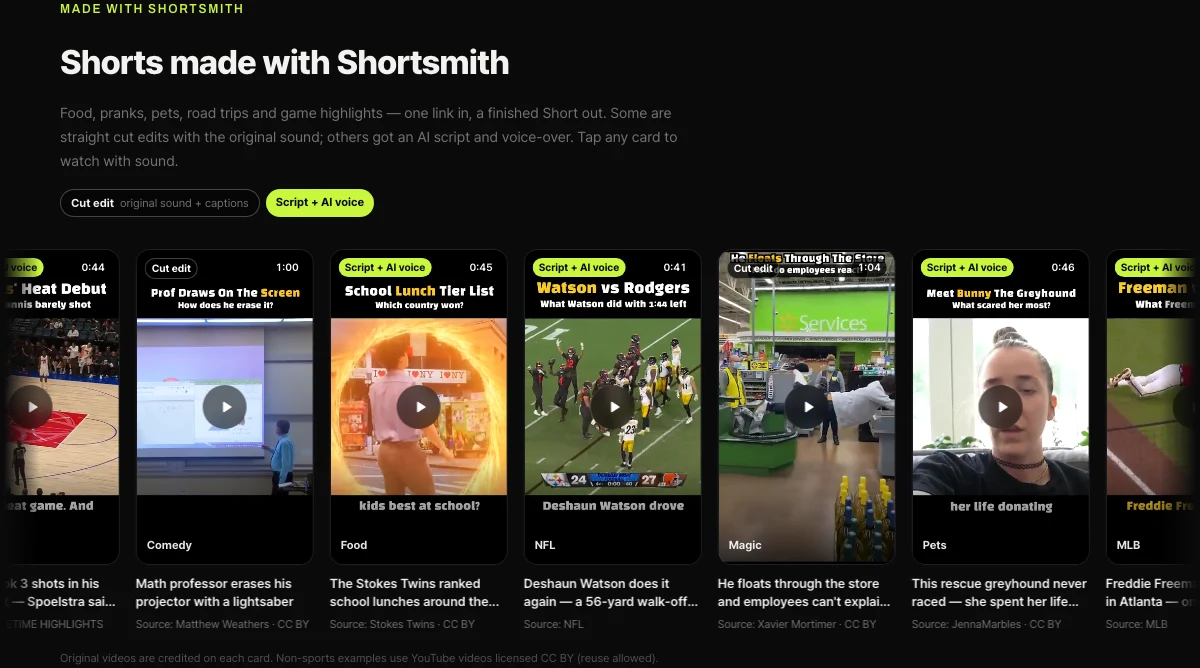
Shortsmith reads the whole video, suggests three story angles and writes a script and captions that alternate a hook, short commentary and the original audio. Below is the row of real finished Shorts on the Shortsmith home page; the source of each one is credited on its card.
FAQ
How much do Shorts pay per 1,000 views?
There is no fixed amount. The creator pool is split by share of engaged views and creators get 45%, so it varies by country, month and ad market. Check your RPM.
What is an engaged view?
A time someone kept watching after the first few seconds. Loops are excluded, and Shorts revenue and YPP eligibility are based on this number.
Does using music reduce my earnings?
It reduces the part of those views’ revenue that goes to the creator pool (half with one track, one third with two). Your share of the pool and the 45% rate do not change.
Why is RPM lower than CPM?
RPM is after YouTube’s share and includes views that earned nothing; CPM is what advertisers pay before the share.
Where can I see my Shorts revenue?
Once you start earning from Shorts ads, estimated daily Shorts feed ad revenue appears in YouTube Analytics.
Do views from before I accepted the module count?
No. Only engaged views from the day you accepted the Shorts Monetization Module count.
Sources
- YouTube Shorts monetization policies — YouTube Help · checked
- Understand ad revenue analytics — YouTube Help · checked
- Understand your YouTube content performance — YouTube Help · checked