Running a faceless Shorts channel that can be monetized (October 2026)
Shortsmith team · Updated
A Shorts channel that never shows a face can still be monetized. YouTube, Instagram and TikTok have no rule that you must appear on camera. Faceless channels get blocked because of what they post, not because of the missing face: clips stitched together without a story, template videos that look mass-produced, and AI videos with no point of view.
On October 12, 2026 we re-read YouTube's channel monetization policies and AI disclosure rules, its Creative Commons help page, TikTok's Creator Rewards page and Instagram's monetization policies. This guide separates the faceless channels that work from the ones that get blocked, then walks through making commentary Shorts with your own angle using Shortsmith's scripts and AI narration.
Why faceless channels really get blocked
YouTube's channel monetization policies say monetized content should not be mass-produced, generic, repetitive or manipulative, and should be made for viewers' enjoyment or education rather than only to get views. On July 15, 2025, YouTube renamed its "repetitious content" policy to "inauthentic content" and clarified that it covers repetitive or mass-produced content.
In the same update YouTube noted that its reused content policy did not change. That policy covers commentary, clips, compilations and reaction videos, and asks for a meaningful difference between the original video and yours that viewers can recognize. Most faceless channels use other people's footage or stock material, so passing these two policies is what decides monetization.
| Faceless channels likely to be monetized | Faceless channels likely to be blocked |
|---|---|
| Story-driven Shorts that add a question, commentary and a conclusion to the source | Clips and highlight compilations with scenes simply joined together |
| Your own hands, scenery or screen recordings with explanation | Videos stamped out from one template with only the text changed |
| New commentary on videos licensed for reuse (CC BY), with credit | Other people's videos reposted almost unchanged without permission |
| Videos with a point of view that use AI for scripts or voice | Videos mass-produced with AI and no point of view |
Three kinds of faceless channels that work
The first uses your hands and your screen. Cooking hands, travel scenery, study logs and app screen recordings are original even without a face, and they also fit TikTok's Creator Rewards requirement that content be filmed and produced by you.
The second is the commentary channel. It uses other people's videos as material in areas like sports, news or reviews, but explains the question the video raises, the evidence and the answer in your own voice. Choose material licensed for reuse. YouTube's help center explains that videos with a Creative Commons Attribution (CC BY) license can be reused by other creators, who must give credit.
The third is the fact-based explainer. It gathers numbers, records or comparisons into one story. Name your sources on screen or in the description, and even if the format repeats, give each episode a different question and conclusion so it does not read as inauthentic content.
Can you use an AI voice? The disclosure rules
You can use AI voices and AI-assisted scripts. YouTube asks creators to disclose AI use when they create or meaningfully alter realistic content. Its help page gives examples: making a real person appear to say or do something they did not do, altering footage of a real event or place, generating a realistic scene that did not happen, and AI-generated music that is the main focus of the video. In those cases, select "Yes" under "AI use" when you upload in YouTube Studio.
AI narration used for commentary usually falls outside that list, as long as it does not imitate a real person's voice. TikTok, however, asks for labels on realistic AI audio, and Meta adds "AI info" labels to AI content. Because the rules differ by platform, turning on AI disclosure whenever you use an AI voice is the safe choice. Shortsmith's terms of service also ask you to say a voice is AI when you publish videos that use it.
Avoid
AI narration that imitates a real celebrity's voice, or real game or news footage altered with AI, needs disclosure and can be removed. Use narration to say your own point of view, in your own voice or a generic AI voice.
Making commentary Shorts with Shortsmith
Shortsmith is built for faceless commentary Shorts. Paste a long video link and the AI reads the whole video and suggests three story angles. Pick one and it writes a script that opens with a question, moves through evidence and ends with an answer, then picks the matching source clips for each scene. The script answers the question the video raises instead of narrating scene by scene, which makes the meaningful difference the reused content policy asks for easier to reach.
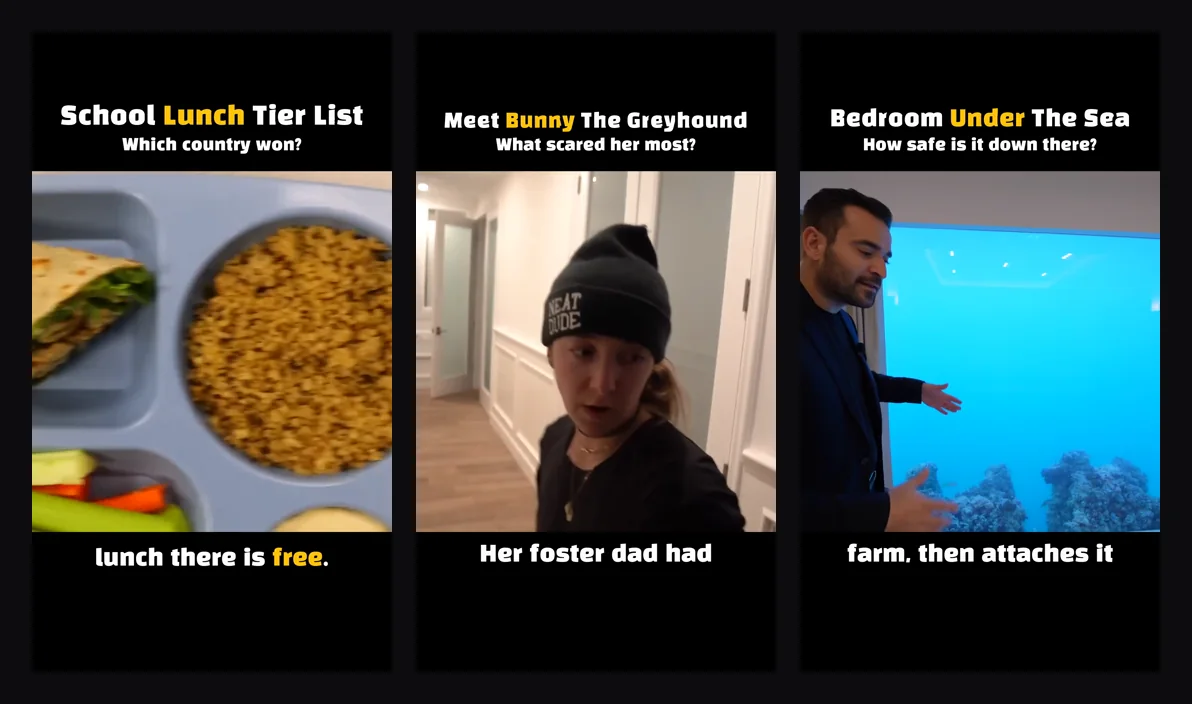
The voice comes from AI narration, and captions and the title at the top are added automatically. The image below shows frames from finished Shortsmith videos made with a script and AI narration. There is no face on screen, yet the question at the top, the source footage and the captions below carry the story.
- Paste a link to a video licensed for reuse, or to your own video. For long videos, choose the part to analyze.
- Pick the story angle that fits your channel's point of view.
- Review the script and edit it. The more of your own wording it carries, the clearer your channel becomes.
- Choose a voice and render. When you post, credit the source and turn on AI disclosure.
Habits that keep a faceless channel going
Without a face, viewers struggle to remember who makes the channel, so its point of view matters even more. Decide on an angle you can describe in one sentence, such as "this channel always shows the twist through numbers" or "this channel points out the moment everyone missed", and shape every title, opening line and conclusion around it.
Second, credit your sources. If you use other people's videos, put the original title, channel and license in the description. Attribution is a condition of CC BY, and channels that consistently name their sources look like transparent commentary channels in review. Third, pace your uploads. Publishing one or two videos a day, each with a different question, keeps you clear of inauthentic content better than stamping out dozens a day.
FAQ
Can a faceless channel join the YouTube Partner Program?
Yes. The Partner Program requirements do not include showing your face. Reviewers check whether the channel meets the reused content and inauthentic content policies.
Will Shorts with AI narration be treated as inauthentic content?
Not just for using AI. The problem is mass-produced videos from one template with no point of view. Commentary with a different question and conclusion in each video fits the policy even with an AI voice.
Can I monetize videos made from CC BY footage?
CC BY allows reuse as long as you credit the creator. Monetization is reviewed separately under the reused content policy, so add commentary and a story that make a meaningful difference from the source.
Can a faceless commentary channel earn TikTok Creator Rewards?
TikTok only rewards content you filmed and produced. Commentary built on other people's footage is unlikely to qualify, while faceless videos made from your own footage, such as hands, scenery or screen recordings, can.
Sources
- YouTube channel monetization policies (reused and inauthentic content) — YouTube Help · checked
- Disclosing use of altered or synthetic content — YouTube Help · checked
- Creative Commons — YouTube Help · checked
- Creator Rewards Program — TikTok Help Center · checked
- Instagram content monetization policies — Instagram Help Center · checked